
sculk.network
One modpack for your Minecraft server and for every player who joins it.
Keep the modpack in GitHub, apply a change once, and the server and every player's launcher follow.
Documentation · Self-host · Develop · Releases · Write a plugin · Contributing
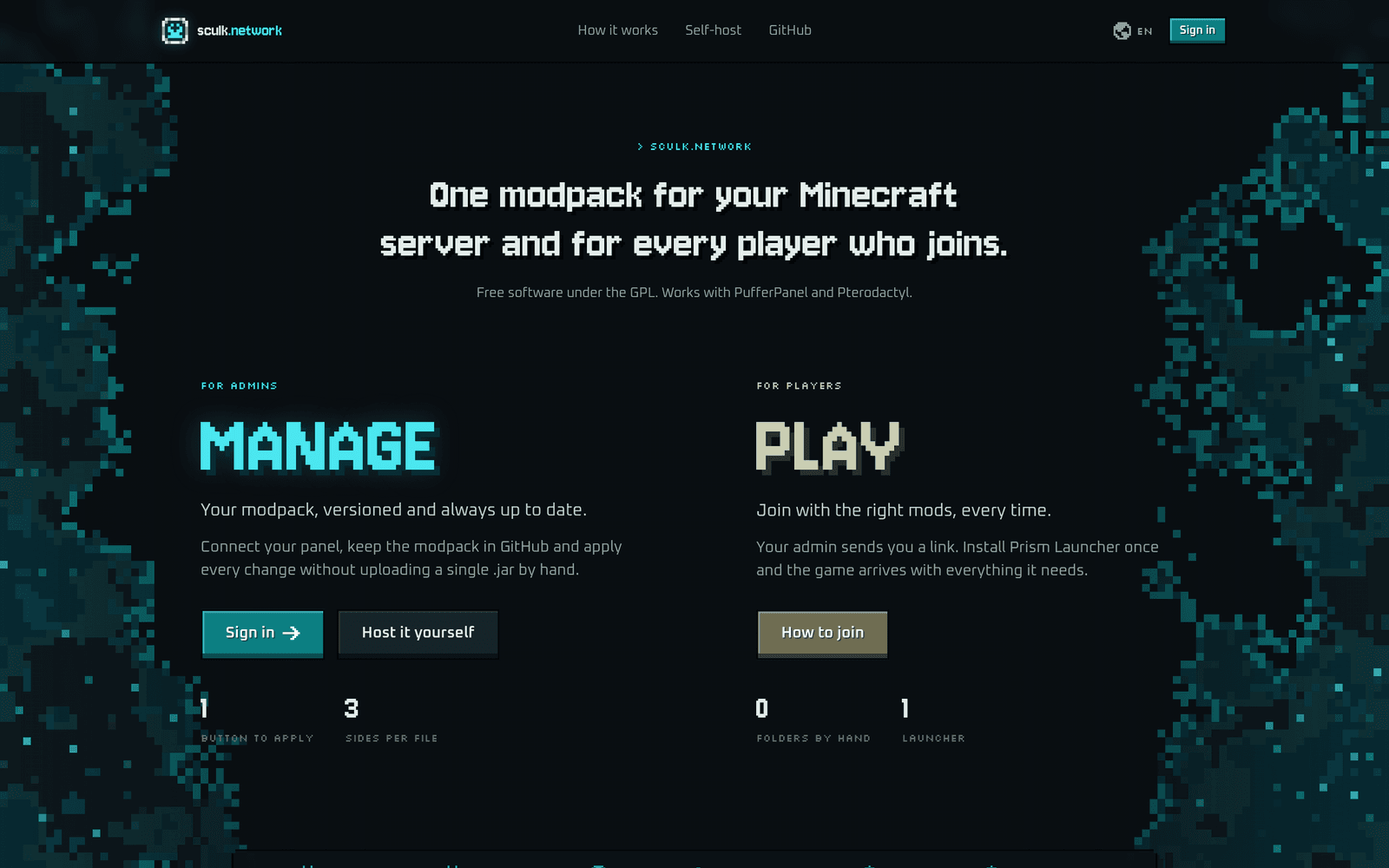
sculk.network manages a Minecraft modpack for a server and for every player who joins it. A server owner connects a PufferPanel or Pterodactyl server, keeps the modpack in a GitHub repository, and marks each mod and config as server-side, client-side or both. When the owner applies a change, the server gets it first. Players get it at their next Prism Launcher start, and never before the server runs it.
What you get#
| Modpack in GitHub | The pack is a repository with a sculk.json manifest. Every change is a commit, every apply is a published version, and History can undo it. |
| Sides per file | Mark each mod and config as server, client or both, so players never download what only the server needs. |
| Server first | Applying a change restarts the server on the new version. Players sync at their next launch and never get a version the server does not run. |
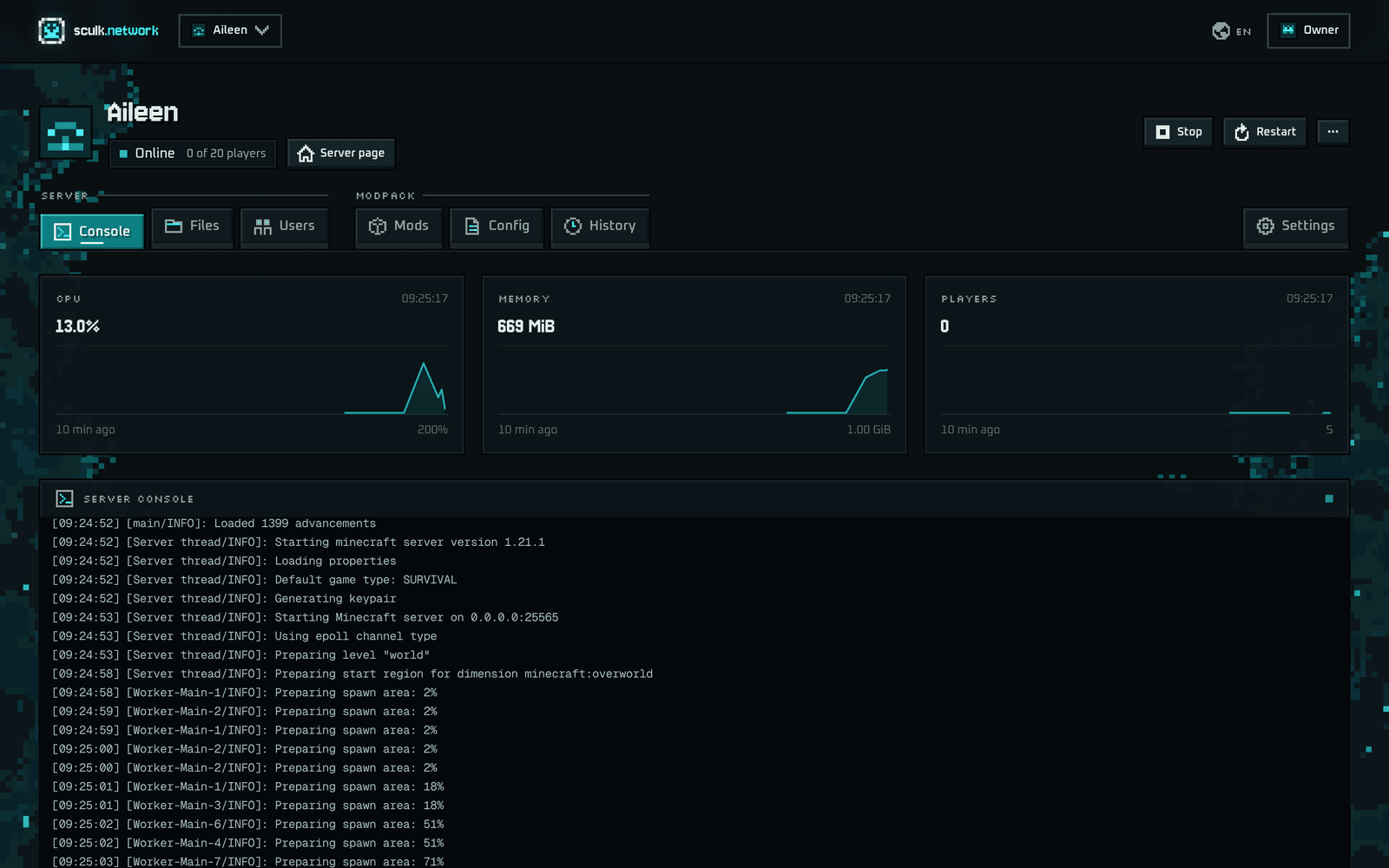
| Panels you already use | PufferPanel and Pterodactyl through declarative backend plugins. Console, files, power and live stats are in the same app. |
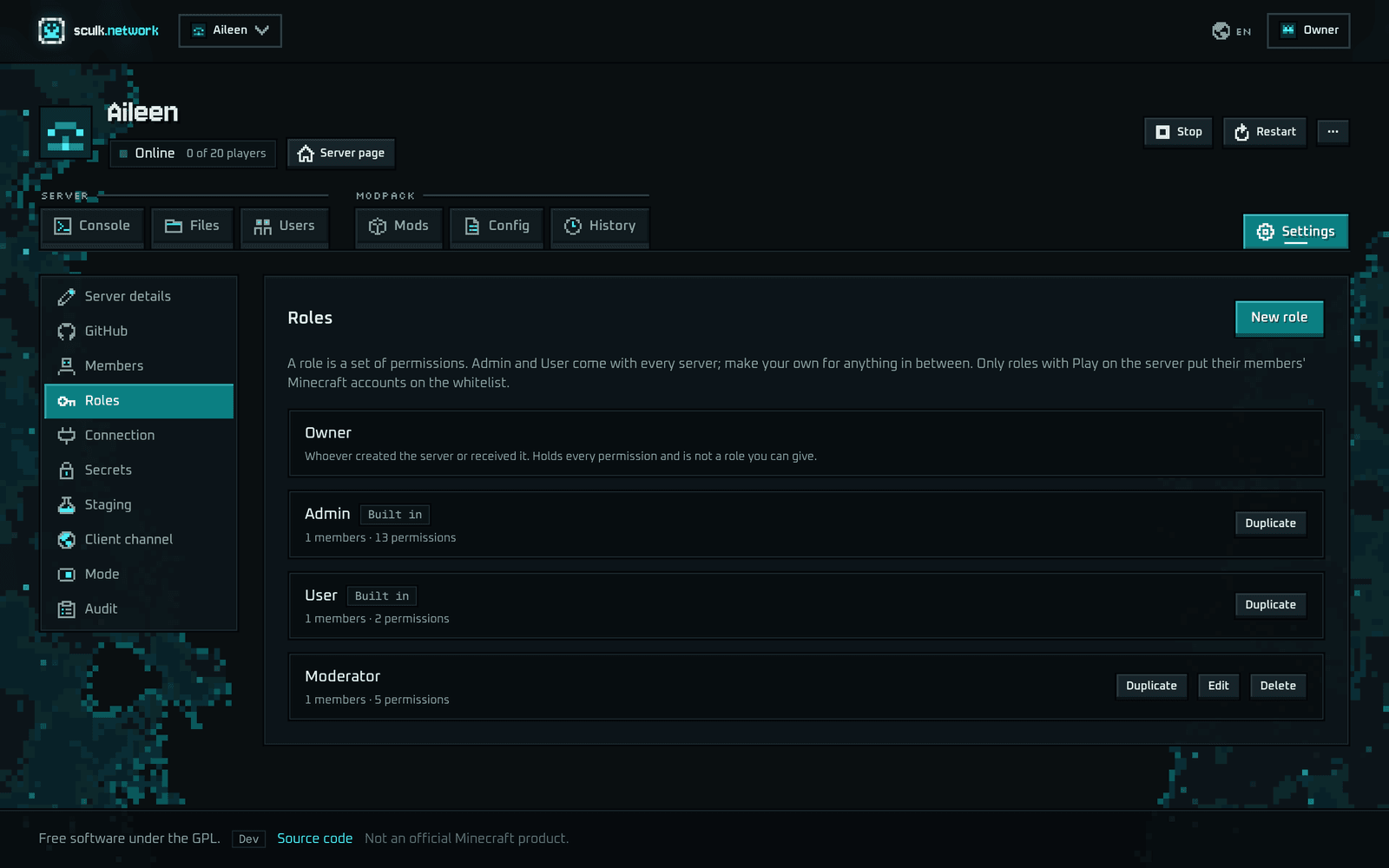
| Players and roles | Owner, admin, moderator, user and custom roles with explicit permissions. Players link their Minecraft account by joining a server, with no Microsoft app approval. |
| One image | The API and the web app are one Docker image on port 8080 with a SQLite file under /data. |
The documentation of sculk.network, OAuthMC and sculkworm is also published as a site: docs.sculk.network for the latest stable releases and nightly.docs.sculk.network for main.
Run it#
Host sculk.network yourself walks through the image, the settings in .env, sign-in, backups and upgrades. The short version:
cp .env.example .env    # then fill in SCULK_BASE_URL, SCULK_MASTER_KEY and one OAuth app
docker compose up -d
The app answers on http://localhost:8080. Set SCULK_PORT in .env to use another host address and port, such as 127.0.0.1:8080 behind an https proxy, and SCULK_IMAGE to run a tagged image instead of building one. The named volume sculk-data holds the database, so docker compose down keeps it and docker compose down -v deletes it.
The pieces#
| Path | What it is |
|---|---|
apps/server |
Hono API, jobs and SQLite migrations |
apps/web |
React web app and landing page, in English and Spanish |
apps/docs |
The documentation site for all three products, built into two Cloudflare Workers (stable and nightly) |
clients/sync |
Java sync jar that Prism Launcher runs before every launch |
packages/manifest |
The sculk.json manifest schema and its logic |
packages/plugins and plugins/* |
The backend plugin format and the PufferPanel and Pterodactyl plugins |
crates/oauthmc |
OAuthMC: verifies a Minecraft account when the player joins a server. Standalone, MIT |
crates/sculkworm |
sculkworm: routes Minecraft connections by hostname and gates them behind a login. Standalone, MIT |
OAuthMC and sculkworm run without sculk.network. sculk.network uses OAuthMC to link Minecraft accounts and registers its servers' routes in sculkworm, see sculkworm integration and OIDC provider.
Develop#
You need Node.js 22 and pnpm 11.
pnpm install
pnpm lint
pnpm typecheck
pnpm test
pnpm build
Pull requests target main. Every night main is published as a nightly, and the maintainers promote a nightly that held up to a stable release; until 1.0.0, stable is the beta. AGENTS.md lists the conventions, the development guide explains branches, CI and the dev server, and the release guide explains channels, versions and feature stages.
pnpm build writes the server bundle to apps/server/dist and the web app to apps/server/public. Run it with node apps/server/dist/index.js. Set SCULK_DATA_DIR to a writable folder when you run outside the image, because the default is /data.
pnpm lane up starts a private copy of the app in Docker, with mock sign-in and an optional PufferPanel and Minecraft server, to try a change by hand. The verify-sculk skill explains how.
License#
sculk.network is free software. You can redistribute it and modify it under the terms of the GNU General Public License as published by the Free Software Foundation, either version 2 of the License or, at your option, any later version. LICENSE holds the text of version 2.
crates/oauthmc and crates/sculkworm are licensed separately under the MIT License (see LICENSE in each crate).